



If you hire an offshore virtual assistant, it is a big move and a smart one. You’re saving time, reducing costs, and finally getting help with the tasks that slow you down. But the truth is, even the best hire can fail without the right start.
It is important to set the tone for how they work, what they own, and whether they stay useful or become another thing you manage. So here’s a simple, proven way to set your offshore VA up for success, whether they’re handling your calendar, social media, invoices, or client tasks.
Why Onboarding Matters More Than Hiring
Hiring an offshore virtual assistant is a very strategic decision, but onboarding is even more crucial. It determines whether that hire becomes a high-value partner or a new source of friction. Even elite VAs can fail without direction. You need to set up everything, including communication habits and workflow rhythm. This also determines how confidently they take ownership of recurring tasks.
Most founders underestimate how much clarity a VA needs to truly excel. They assume a great hire will “figure it out,” but the opposite is true: the more structured the onboarding, the faster your VA becomes a reliable extension of your operations. When you hire an offshore virtual assistant, success is built in the setup, not the job description.
Give Them a Role, Not Random Tasks
The quickest way to frustrate an offshore VA is to treat them like a catch-all problem solver. When responsibilities change every hour, they are never able to master them. Role clarity versus task dumping is the foundation for speed, confidence, and consistency.
Clear role definitions look like:
- “You are the calendar owner.”
(Not: “Help manage my calendar when you can.”) - “You are responsible for weekly invoicing.”
(Not: “Sometimes I’ll send you bookkeeping tasks.”) - “You manage our content scheduling and posting.”
(Not: “I’ll send you posts here and there.”)
A defined role allows your VA to build repeatable processes, improve week over week, and take proactive ownership. For an offshore virtual assistant, this clarity is even more important because they rely on routines and predictable workflows to stay aligned across time zones.
Build a Simple, Structured First Week
The first week shouldn’t feel like a firehose. A structured onboarding plan gives your VA the confidence to perform and the context to take ownership quickly. A simple 5-day framework works incredibly well for almost every function.
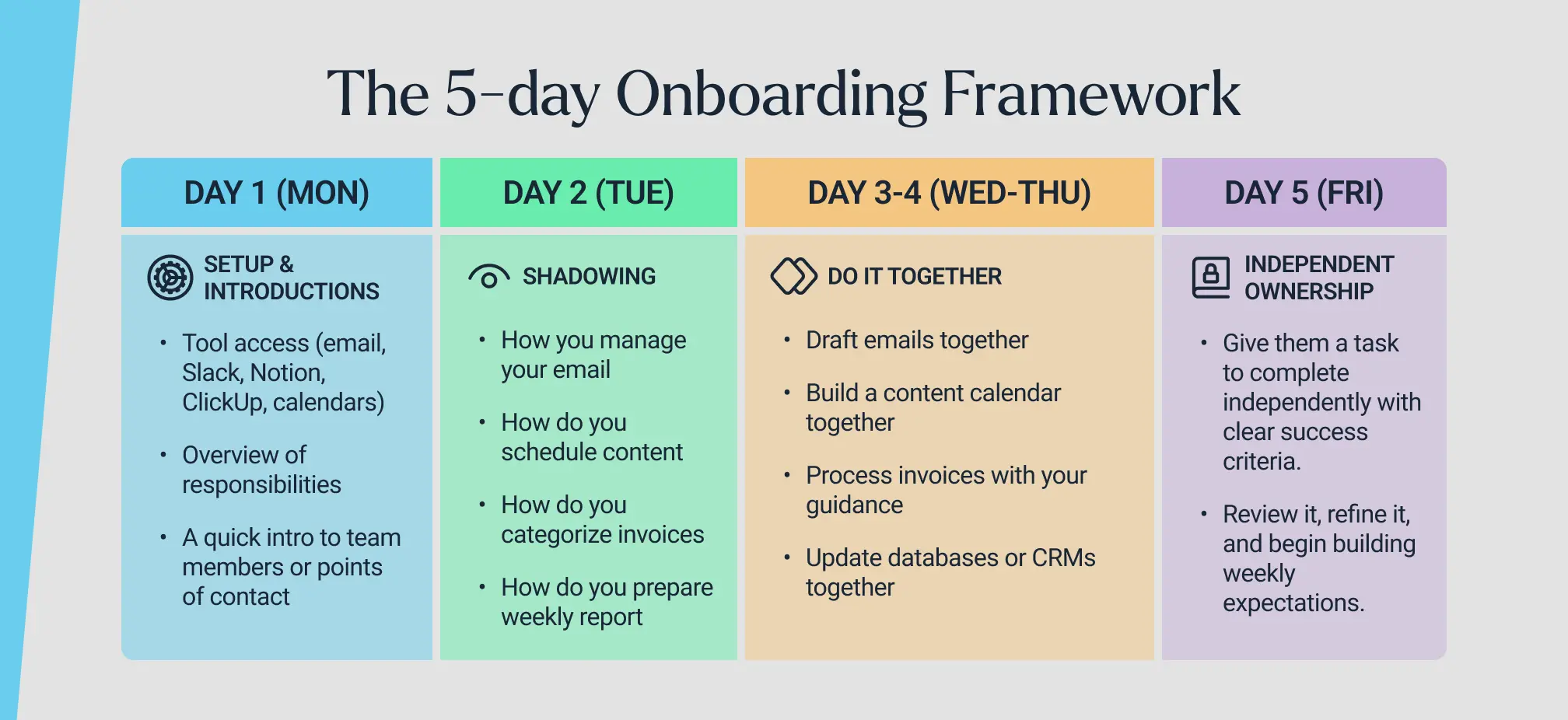
Day 1: Setup & Introductions
- Tool access (email, Slack, Notion, ClickUp, calendars)
- Overview of responsibilities
- A quick intro to team members or points of contact
Day 2: Shadowing
They watch how you do the task:
- How you manage your email
- How do you schedule content
- How do you categorize invoices
- How do you prepare weekly reports
Day 3–4: Do It Together
You complete the task side-by-side:
- Draft emails together
- Build a content calendar together
- Process invoices with your guidance
- Update databases or CRMs together
Day 5: Independent Ownership
- Give them a task to complete independently with clear success criteria.
- Review it, refine it, and begin building weekly expectations.
Give Feedback Early, Often, and Simply
When you hire an offshore virtual assistant, the quality of your early feedback determines the speed of their growth. Even highly capable VAs need direction, not because they lack skill, but because they are adapting to your standards. The biggest onboarding mistake founders make is waiting too long to correct small errors, which later turn into ingrained habits. Early feedback is the single fastest way to align expectations before misunderstandings become systems.
Micro-feedback is the most effective method. These quick corrections prevent misalignment and help your VA understand what “done right” looks like. Rather than formal weekly reviews, you simply provide real-time course corrections. This could be a quick note about formatting, a suggestion for a softer tone, a reminder about structure, or praise for an approach you want them to repeat. These micro-adjustments help your offshore VA understand your preferences faster than any long SOP ever could.
Define Communication Expectations Explicitly
Communication is the operating system of every successful VA relationship, and it becomes even more essential when you hire an offshore virtual assistant. Many founders assume communication preferences are obvious, but they’re not. With unclear communication, a lack of clarity quickly leads to delays, friction, or inconsistent execution.
Set communication expectations clearly from day one. Explain whether you prefer daily check-ins or weekly summaries. Share whether you want updates inside Slack, inside your project management tool, or via email; and whether you expect them to use Loom for async explanations or attend live meetings when available.
Be explicit about response time expectations as well. If you want replies within minutes for urgent items and within an hour for everything else, your VA needs to know that upfront. A powerful habit to build early is the “confirm next steps” expectation.
Leaders who work best with offshore virtual assistants are those who expect their VA to recap decisions, outline next steps, and restate responsibilities after every meeting or message. This prevents misunderstandings and builds a rhythm of accountability that pays dividends every day.
Set Up Tools & Access Correctly on Day One
If the first week sets the tone, then the first day sets the infrastructure. The faster your offshore VA can access tools, documents, calendars, dashboards, and communication channels, the faster they can start contributing. Delayed access creates dependency, slows confidence, and interrupts momentum. These are all completely avoidable with a strong day-one setup.
Your offshore virtual assistant should receive access to your platforms (Slack or Microsoft Teams), your workspace tools (Google Workspace or Office 365), and your organizational infrastructure (Notion, ClickUp, Asana, Trello).
A well-documented onboarding folder containing SOPs, templates, naming conventions, brand examples, and key links allows your VA to start forming mental models of how your business operates.
A structured setup reduces how often your VA needs to ask for help and accelerates their ability to work independently. When the digital environment is ready, your offshore VA can immediately start contributing instead of waiting around for permissions or clarifications.
Teach Ownership, Not Obedience
The biggest benefit when you hire an offshore virtual assistant is ownership. The highest-value VAs don’t wait for instructions every hour. They anticipate needs and manage responsibilities proactively to protect your time by thinking ahead. This shift from “task follower” to “partner in execution” begins with how you frame their role.
Ownership is built when you establish clear boundaries and recurring responsibilities. When your VA knows what they own, they develop expertise through repetition. Outcomes-based goals are especially powerful. Instead of assigning a list of tasks, you define what success looks like.
When a VA operates with ownership, they begin making suggestions and taking initiative to improve processes. They stop waiting for direction and start managing the system for you. This is how offshore virtual assistants become irreplaceable.
Common Mistakes to Avoid When Managing an Offshore VA
No Clear Role Definition
When a VA is hired without a specific scope, they’re forced to guess priorities. This leads to inconsistent output and slows down their ability to build expertise. Clear role ownership creates predictable performance.
No Examples of What “Good” Looks Like
Instructions alone aren’t enough. Without concrete examples, even simple tasks get misinterpreted. Examples eliminate guesswork and reduce corrections.
Sporadic Communication
Irregular check-ins create uncertainty and inconsistent execution. Offshore VAs rely on steady communication to stay aligned on priorities, deadlines, and expectations.
Expecting Perfection Without Training
A VA can’t magically know your preferences, tone, or workflow. Even the most skilled offshore virtual assistant needs guidance during the first few weeks to match your standards.
Withholding Early Feedback
Delaying feedback allows small mistakes to become habits. Micro-feedback that is quick, simple corrections, keeps work on track, and accelerates confidence.
Overloading Too Quickly
Giving too many tasks before a VA has mastered the basics leads to overwhelm and lower-quality work. Scaling their workload gradually produces better long-term performance.
Want help hiring a VA that’s easy to train and quick to add value?
At TalentGems, we match U.S. companies with proactive, tool-savvy offshore virtual assistants across Latin America and Southeast Asia.
Whether you need help with:
- Admin & scheduling
- Social media & content
- Bookkeeping & reporting
We’ll find you someone who gets it and grows with you.
Frequently asked questions
How long does it take for an offshore virtual assistant to become productive?
Most VAs begin contributing immediately, but full confidence and independence typically develop within 30 days when onboarding is structured and feedback is consistent.
What should I delegate first to an offshore VA?
Start with repeatable tasks you currently handle: calendar management, inbox management, reporting, scheduling, content posting, research, or invoice processing. These tasks build momentum and trust.
How do I communicate effectively with an offshore virtual assistant?
Define communication rhythms clearly, such as daily check-ins or weekly summaries, response-time expectations, preferred tools (Slack, email, Loom), and how you want next steps confirmed.
What tools do offshore VAs need access to on day one?
Email, calendar, shared drives, task management tools (ClickUp, Asana), SOPs, templates, password manager access, and any platform relevant to their role. Proper setup accelerates performance.
How much feedback should I give a new offshore VA?
More than you think. Short, immediate feedback loops (10–30 seconds) are ideal during the first two weeks. They prevent bad habits and align quality quickly.
What’s the difference between outsourcing tasks and hiring an offshore virtual assistant?
Task outsourcing is transactional. Hiring an offshore VA is relational. They integrate into your workflow, own responsibilities, communicate regularly, and operate as an extension of your team.
How do I know if my offshore VA is a good fit?
They communicate clearly, confirm next steps, improve week-over-week, follow processes consistently, and begin anticipating what needs to be done without being asked.
What mistakes should I avoid when hiring a virtual assistant?
Unclear roles, poor communication, lack of examples, delayed feedback, overload in week one, and expecting perfection without training. These mistakes cause performance issues.
Do I need SOPs before hiring an offshore virtual assistant?
You don’t need full SOPs, but you do need clear examples, expectations, structured workflows, and templates. These accelerate onboarding dramatically.